
Corporate India at present is more indebted than all state govts put together.

Banks in India must have a modern approach, suggests a panel comprising of banking bigwigs.
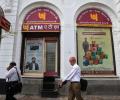
PNB has rich experience in the integration of commercial banks.

Bond issuances dipped 31.4% during January-June
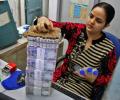
The move will have cascading effects for lot of related sectors

The improved outlook on the Government of India announced by rating agency Moody's might need to be viewed with some scepticism. There is no doubt the performance of the Indian economy has sharply improved from the deep trough it hit last year. But the ability of the second largest global ratings agency to assess an upside and downside before events make everyone wise about India has been dismal for a long time, as the chart shows.

'To the believers of crypto regulations, I have only one question to ask, how will you regulate it?'

India's economic image is not affected due to Adani Group's recent decision to pull out Rs 20,000 crore FPO (follow-on public offers) amid allegations of financial wrongdoings, Finance Minister Nirmala Sitharaman said on Saturday.

With March 2016 being the final quarter when banks will have to disclose their stressed assets, the markets are assuming the worst is yet to come

It will be headed by Secretary, Department of Financial Services.

In the June quarter of FY24, 51 per cent of consumers who took small-ticket personal loans already had more than four credit products at the time of accessing yet another new loan, compared with just 17 per cent in the June quarter of FY20, points out Tamal Bandyopadhyay.

Investors' wealth eroded by over Rs 4.90 lakh crore on Friday amid a sharp fall in equities. The 30-share BSE Sensex tanked 1,020.80 points or 1.73 per cent to settle at 58,098.92. During the day, it tumbled 1,137.77 points or 1.92 per cent to 57,981.95. The market capitalisation of the BSE-listed firms plummeted by Rs 4,90,162.55 crore to Rs 2,76,64,566.79 crore on Friday.

'Considering that an Internet company's market value is largely determined by its direct access to consumers for digital services, and largely served outside a sovereign country's control, it would appear reasonable in trade terms to discuss fees for a seat at the proverbial 'table' of opportunities in the largest open consumer market,' argues Venki Nishtala.

'I found it unbelievable that L&T said 45,000 jobs were waiting to be filled because of unavailability of suitable skillsets.' 'So, when the Opposition sweepingly says there are no jobs, I'm sorry... I'm not saying it's raining jobs, but there are jobs. The (skill) gap has to be bridged.'

The BRICS Summit tonight decided to establish the new development bank with an initial authorised capital of $100 billion.

The Arun Jaitley-led finance ministry reiterated banks should act tough on wilful defaulters.

'Earnings will be the catalyst for markets to march higher from here on out.'

The government is considering a proposal to privatise some state-owned banks in phases.

Which entrepreneur would willingly part with her or his hard-earned money for grasping, self-serving politicians? asks Debashis Basu.

'This issue is related to national security because they were compromising the entire capital markets's core infrastructure by leaking confidential information.' 'What would have happened if the servers had come down?' 'Or some confidential information leaked to terrorists who could have knocked out our capital market?'
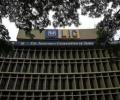
The next step for the Life Insurance Corporation of India is to approach market regulator Sebi, as the bank, which is also state-owned, is a listed entity.

Metal stocks fell on Tuesday, with the S&P BSE metal index sliding 2.8 per cent compared to the 0.64 per cent fall in the benchmark S&P BSE Sensex

Indian banks have started exploring opportunities in the space, including lending to crypto exchanges, and accepting bitcoins as collateral, among others.

Sensex, Nifty end the day in red on unfavourable cues from global markets.
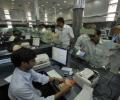
The total quantum of non-performing assets in the Indian banking system increased to Rs 7.33 trillion as of June 2017, from Rs 2.75 trillion in March 2015.
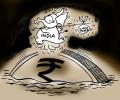
Fitch Ratings on Wednesday said India's high fiscal deficit would pose a challenge in lowering the debt to GDP ratio, which is expected to rise above 90 per cent in the next five years. It said India entered the pandemic with little fiscal headroom from a rating perspective. Its general government debt/GDP ratio stood at 72 per cent in 2019, against a median of 42 per cent for 'BBB' rated peers.

'Your decisions should not be driven by your view on the market, but by your objectives, risk appetite, and time horizon.'
With their weak metrics and high bad loans, India's state-run banks have not been investor favourites

Banks are in need of government support to manage the stressed assets

'The approach today is, instead of giving loans to 100 MSMEs, let us give one loan to a big-ticket corporate.' 'And so many of these big fish deceived the banks and the banks are in the doldrums now with high NPAs.'

India has a unique window of opportunity to effectuate long-lasting structural change in its banking sector, says Riju Agrawal.

Instead of getting swayed by market gyrations, investors must stay invested for the long term, advises Sarbajeet K Sen.

Tactical investors should have an investment horizon of around six months to one year, long-term investors should stick around for 10 years or more.

Private sector lenders have been communicating to their customers about their strong capital positions but it has not put depositors at ease.

The Securities and Exchange Board of India (Sebi) is in the process of issuing a standard operating procedure (SOP) for designated depository participants (DDPs) regarding disclosures and onboarding of foreign portfolio investors (FPIs), according to a regulatory document seen by Business Standard. DDPs act as a link between the markets regulator and overseas investors. The SOP, framed in consultation with the industry, aims to bring consistency across all players and avoid any form of regulatory arbitrage.

Currently bankers are trying to stave off bankruptcy even as media reports said Etihad Airways, which already owns 24 per cent in the airline, has teamed up with the Hindujas to buy the airline.

The evolving RBI-government relationship, a reversal in the interest rate cycle and return to profitability will dominate bankers' conversation this year, says Tamal Bandyopadhyay.

At its 58th annual convocation to be held on March 22, Bhattacharya will be conferred the prestigious Sir Jehangir Ghandy Medal for industrial and social peace.

PEs and VCs are taking a closer look at their bouquet of investments. Leading voices in the sector are categorical that cash-burn rates -- that's blowing up equity to acquire market share -- as a business model can't continue to be the polestar.
Any change in rates would mean more volatility; else, poll outcome-fuelled rally expected to continue.
